
As early childhood teachers, we write reams of pedagogical documentation each term. We observe children building block towers, resolving sandpit disputes, and participating in group stories. But how often does our documentation capture the neurological architecture unfolding beneath the surface?
Bridging the divide between educational neuroscience and daily planning does not mean turning our documentation into dry medical reports. Rather, it equips educators with a scientific lens that reframes ordinary play into profound cognitive breakthroughs.
The Core Pillars of Executive Function (Harvard Center on the Developing Child)
Neuroscience reveals that early childhood is the critical window for constructing executive function—the cognitive air-traffic control system of the brain. The Harvard Center on the Developing Child identifies three interconnected neuro-capacities that educators can observe and document every day:
Working Memory
The capacity to hold and manipulate information over short intervals (e.g., remembering a three-step instruction or holding a design concept in mind while searching for blocks).
Inhibitory Control
The nascent neurological ability to resist impulsive urges, filter distractions, and delay gratification (e.g., waiting for a swing turn or resisting knocking down a peer's tower).
Cognitive Flexibility
The capacity to switch gears, adapt to changing rules, and innovate when plans fail (e.g., choosing a different material when sticky tape runs out).
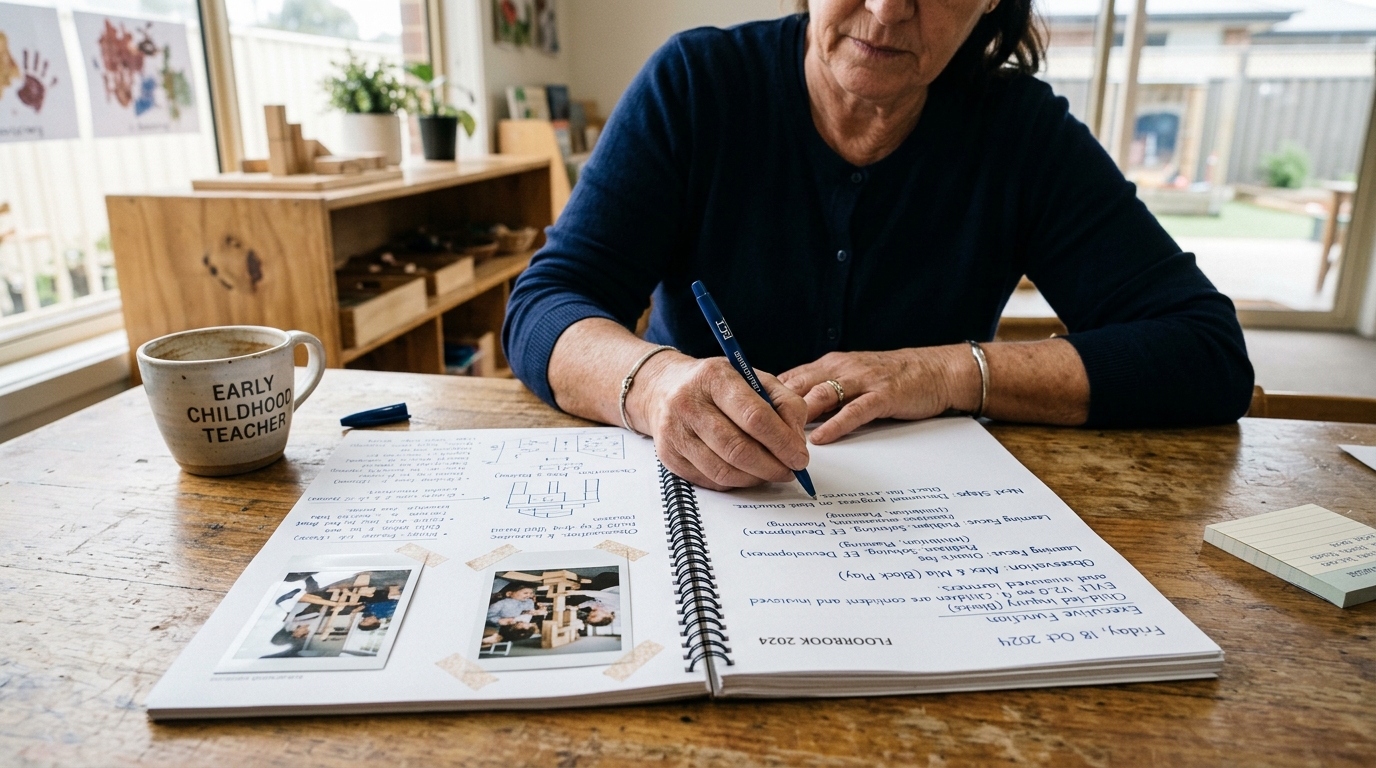
**ACECQA Assessment and Planning Cycle (Element 1.3.1):** High-quality documentation moves past recording what children did to critically analysing *how* they learned. Analysing observations through a neurobiological lens fulfills the expectation for rigorous, evidence-informed pedagogical analysis.
Reframing EYLF Outcomes Through Brain Science
When educators understand early neurobiology, the EYLF V2.0 Outcomes expand with greater pedagogical depth:
Outcome 1 (Identity & Agency)
Self-efficacy develops when children experience manageable challenges that stimulate the prefrontal cortex without overwhelming the autonomic nervous system.
Outcome 3 (Wellbeing)
True wellbeing is not merely affective compliance or smiling; it is the physiological ability of a child's nervous system to experience stress, receive co-regulation, and return to an regulated homeostatic baseline.
Outcome 4 (Learning & Inquiry)
Curiosity activates dopamine release in the brain's mesolimbic pathway, transforming exploration from a routine task into sustained, deeply encoded neurological memory.
3 Practical Observation Upgrades for Your Team
Upgrade your documentation this week by replacing superficial action statements with neuro-informed analysis:
Example 1
Moving Beyond Turn-Taking: Instead of writing 'Cooper shared the dinosaur nicely,' document the neural skill: 'Cooper demonstrated emerging inhibitory control and social cognition by pausing his impulse to keep the figurine, navigating a negotiated turn with Noah.'
Example 2
Documenting Persistence as Cognitive Flexibility: Instead of 'Aria's sandcastle crumbled and she tried again,' write: 'Aria demonstrated high cognitive flexibility; following the collapse of her wet-sand arch, she adapted her construction strategy by adding dry sand to modify texture and load-bearing strength.'
Example 3
Scaffolding Working Memory: In your 'Next Steps / Future Planning', intentionally design experiences that stretch working memory capacity: multi-step cooking recipes, obstacle courses requiring sequencing, or complex inquiry webs.
**Critical Reflection for Educational Leaders:** Review three random observations from your room's planning folder this week. Do they describe superficial child behaviour, or do they illuminate the emerging executive functioning and neural pathways being wired through play?