If your numeracy programming rarely progresses past chanting numbers from one to ten during morning mat time, you are in good company. Many early childhood teachers express uncertainty about how to teach rich mathematical concepts without resorting to dry worksheets or disjointed rote drills.
The secret to vibrant, developmentally responsive STEM in kindergarten is leaving behind passive whole-group instruction and establishing a structured, 1-hour interactive mathematics rotation model.
What the Research Demonstrates: Clements & Sarama's Early Math Trajectories
Pioneering research by Douglas Clements and Julie Sarama (2009, 2014) shows that young children possess sophisticated mathematical capabilities that often go untapped in preschool. Their research into early learning trajectories highlights that math understanding builds through active manipulation of physical objects paired with intentional mathematical discourse.
Perceptual vs Conceptual Subitising
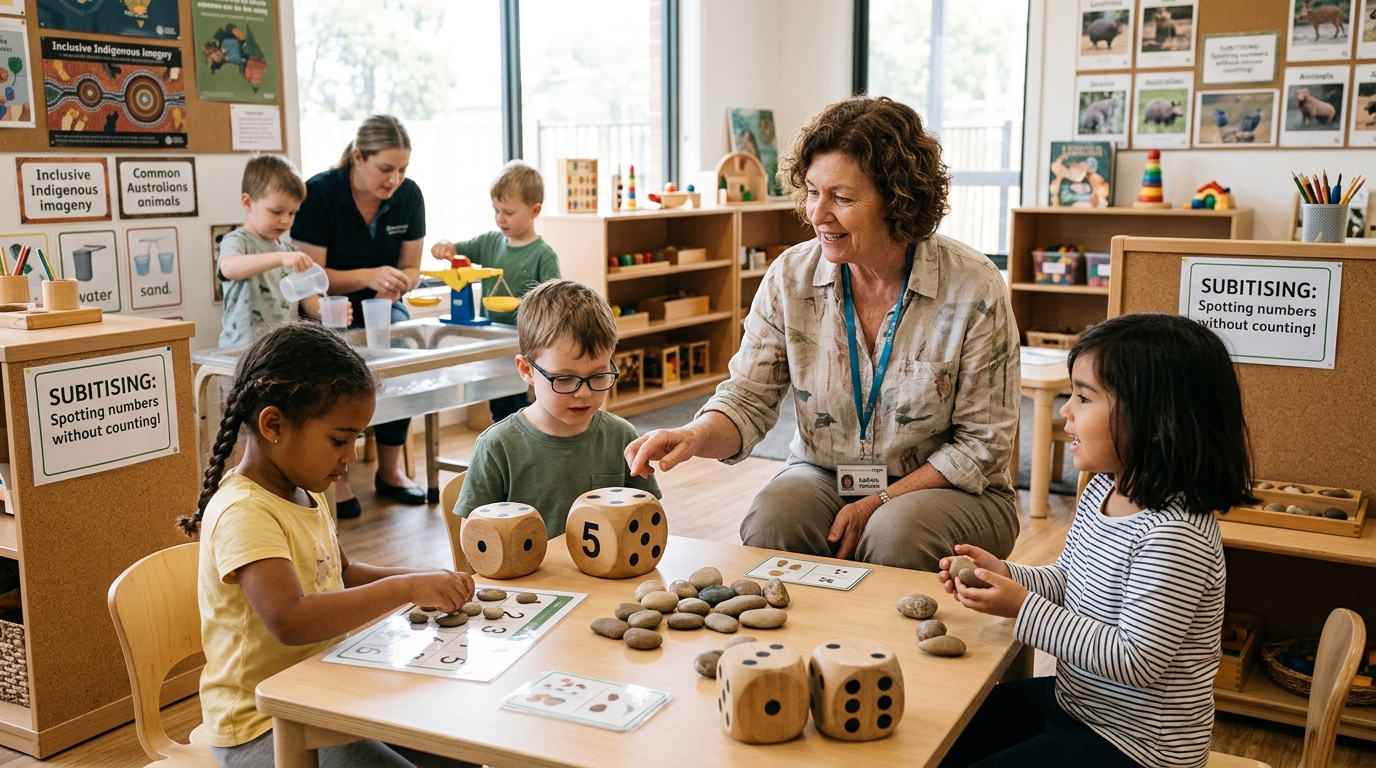
Clements and Sarama distinguish between perceptual subitising (instantly seeing 1–3 items without counting) and conceptual subitising (recognising a group of 5 as a 3 and a 2). Small-group stations allow educators to scaffold this vital precursor to addition.
Spatial Reasoning as a STEM Predictor
Research across cognitive science reveals that spatial visualization (mental rotation, block construction, patterning) is one of the strongest early childhood predictors of future STEM competence.
Mitigating Executive Fatigue
Whole-group carpet instruction demands high inhibitory control that quickly drains 4-year-olds' cognitive reserves. Small groups of 4–5 children slash wait times and allow for intensive sustained shared thinking.
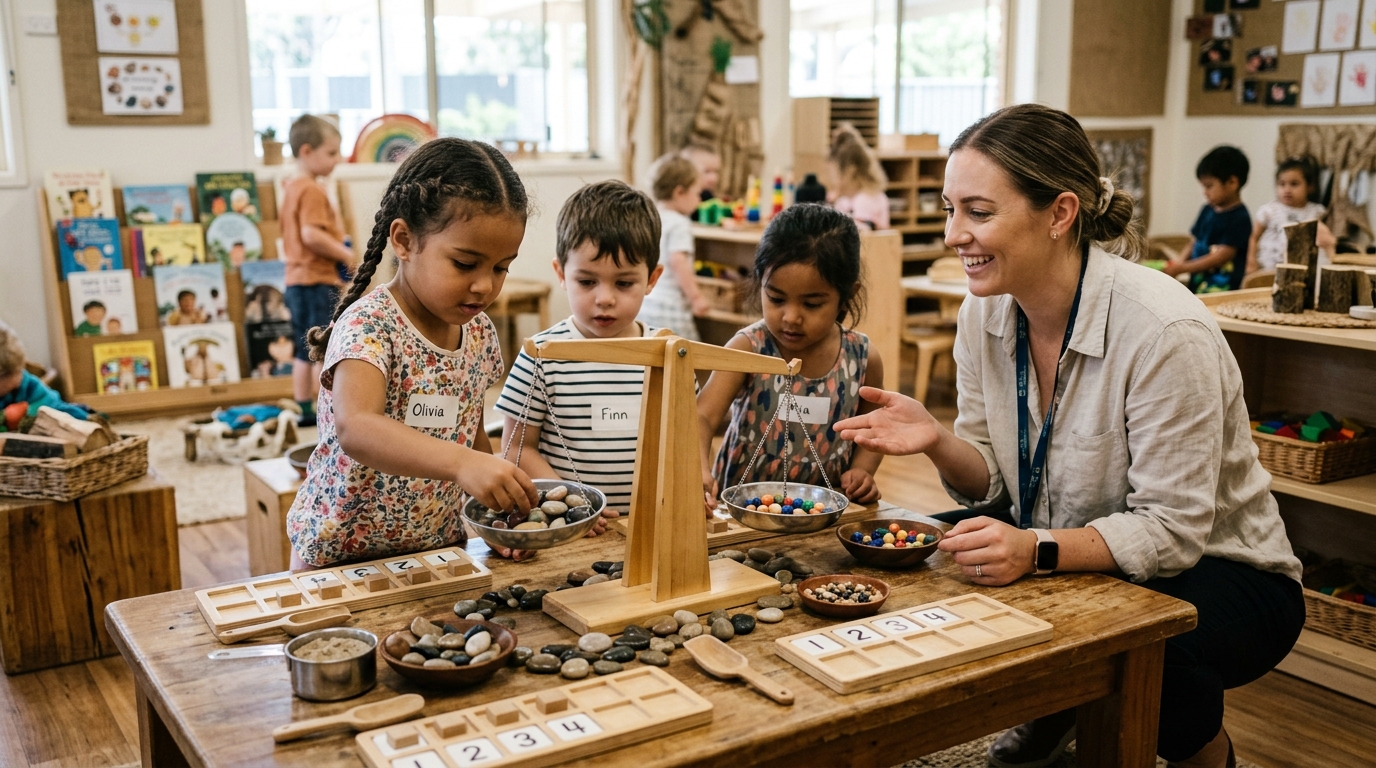
**Evidence Insight (AERO Practice Guides):** The Australian Education Research Organisation emphasizes that intentional teaching in early numeracy involves explicit modeling of comparative vocabulary—such as 'heavier,' 'lighter,' 'equilibrium,' 'more,' and 'pattern sequence'—within meaningful hands-on contexts.
3 Structured Stations for a Dynamic Kinder Maths Hour
Divide your room into three distinct numeracy zones. After a 5-minute whole-group carpet provocation, divide children into small teams who spend 15 minutes at each station, transitioning with a gentle chime.
Station 1
Educator-Led Targeted Skill (Subitising & Number Sense): The ECT sits here. Use large wooden dot dice, ten-frame trays, and river stones. Flash dot cards for two seconds and ask: 'How many did your brain photograph?' Prompt children to articulate how they saw it ('I saw two on top and two on the bottom').
Station 2
Tactile Measurement & Equilibrium (Sensory Science): Set up a double-pan wooden balance scale, kinetic sand, scoops, and calibrated wooden bowls. Children explore weight and mass empirically: 'How many small pebbles balance one large banksia pod?'
Station 3
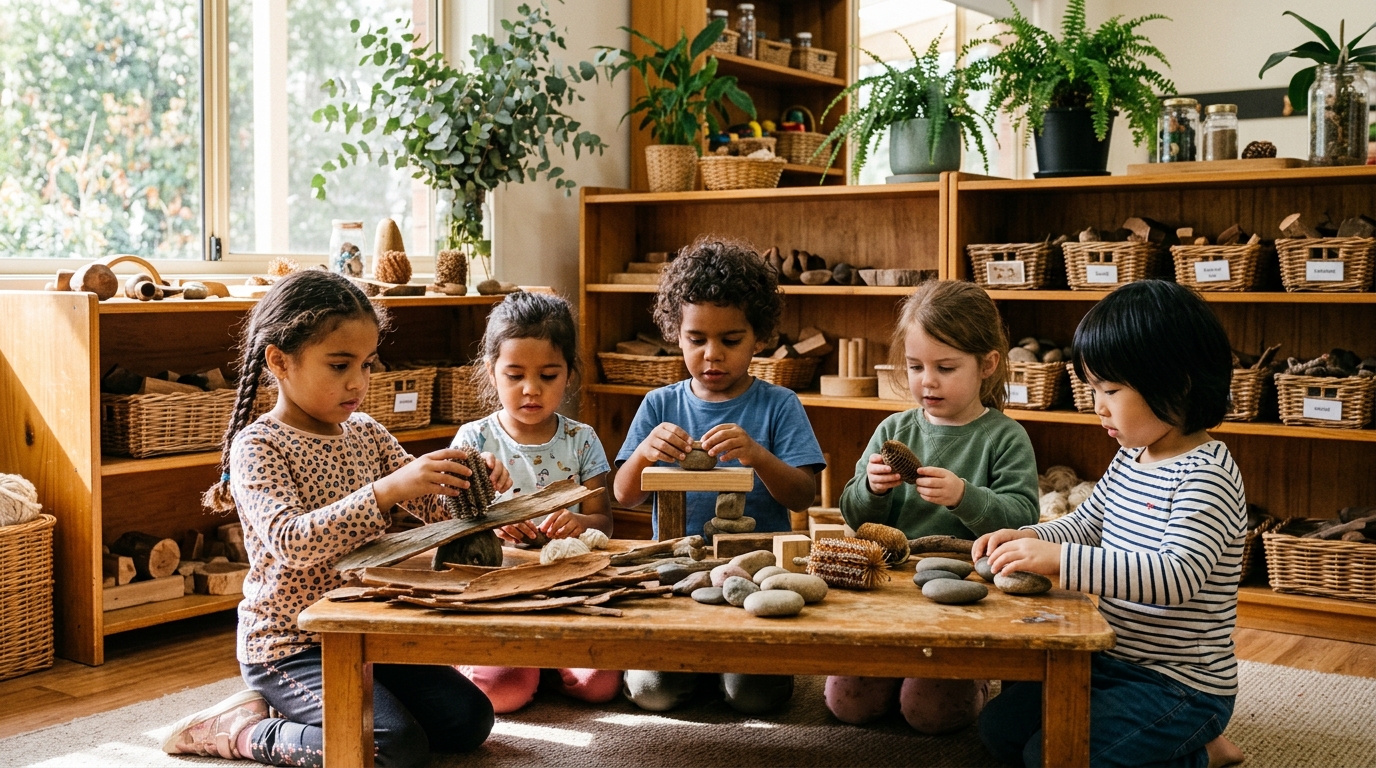
Spatial Geometry & Structural Engineering (Unit Blocks): Provide hardwood unit blocks, translucent magnetic tiles, and architectural blueprint challenge cards. Children investigate symmetry, tessellation, load-bearing balance, and two-dimensional to three-dimensional transformations.
**EYLF V2.0 Connection (Outcome 4.2 & 5.4):** Children transfer and adapt what they have learned across different contexts, exploring mathematical concepts such as spatial awareness, measurement, pattern, and number structure.
**Busy ECT Pro-Tip:** Keep Stations 2 and 3 completely self-sustaining so children can explore autonomously without interrupting the rich, intentional teaching conversations taking place at Station 1.