If you run an emergent or inquiry-based kindergarten programme, you likely face a familiar dilemma: how do you document learning that changes direction as quickly as your children do? Traditional planning binders and digital app portfolios often struggle to capture the messy, organic, and deeply collaborative spirit of authentic play-based pedagogy.
Enter the Floorbook—a shared, living document that transforms how early childhood educators record student thinking, track open inquiries, and co-construct curriculum alongside children.
Pioneered by Scottish educational consultant Claire Warden, Floorbooks® have become one of the most respected tools in Australian early childhood education for authentic pedagogical documentation and child-led planning.
What is a Floorbook?
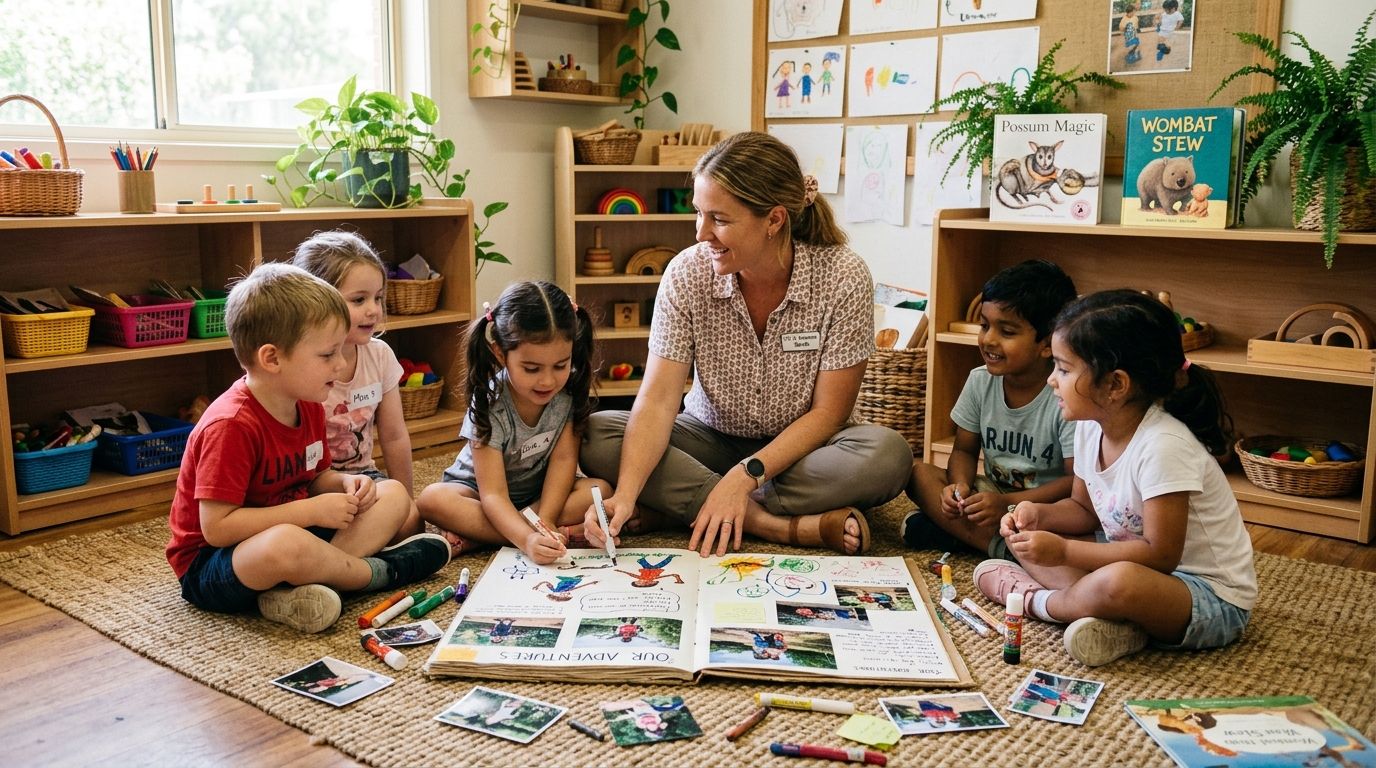
A Floorbook is exactly what it sounds like: an oversized, blank book used directly on the floor. It is emphatically not an adult-curated scrapbook crafted for parents after the fact. Rather, it is a dynamic, shared learning canvas where children and educators co-author the narrative of their discoveries.
Because it lives on the floor at children's physical level, learners have unrestricted access to gather around it, lay on their stomachs, revisit past conversations, and contribute emergent ideas collaboratively.
Large Physical Format
Size matters. The book must be spacious enough for a small cluster of children to gather shoulder-to-shoulder, look at photographs, and hold collaborative learning dialogues.
Child-Centred & Democratic
Children's theories, wonderings, and authentic voice take precedence over adult pre-determined outcomes or rigid worksheet templates.
Celebrating the 100 Languages
The pages welcome diverse forms of representation—children's drawings, cut-and-pasted play photos, emergent writing, collaged natural loose parts, and verbatim adult scribing.
Permanently Accessible
The book remains accessible in the room throughout the week, allowing children to revisit earlier theories, check evidence, and self-direct the next phase of inquiry.
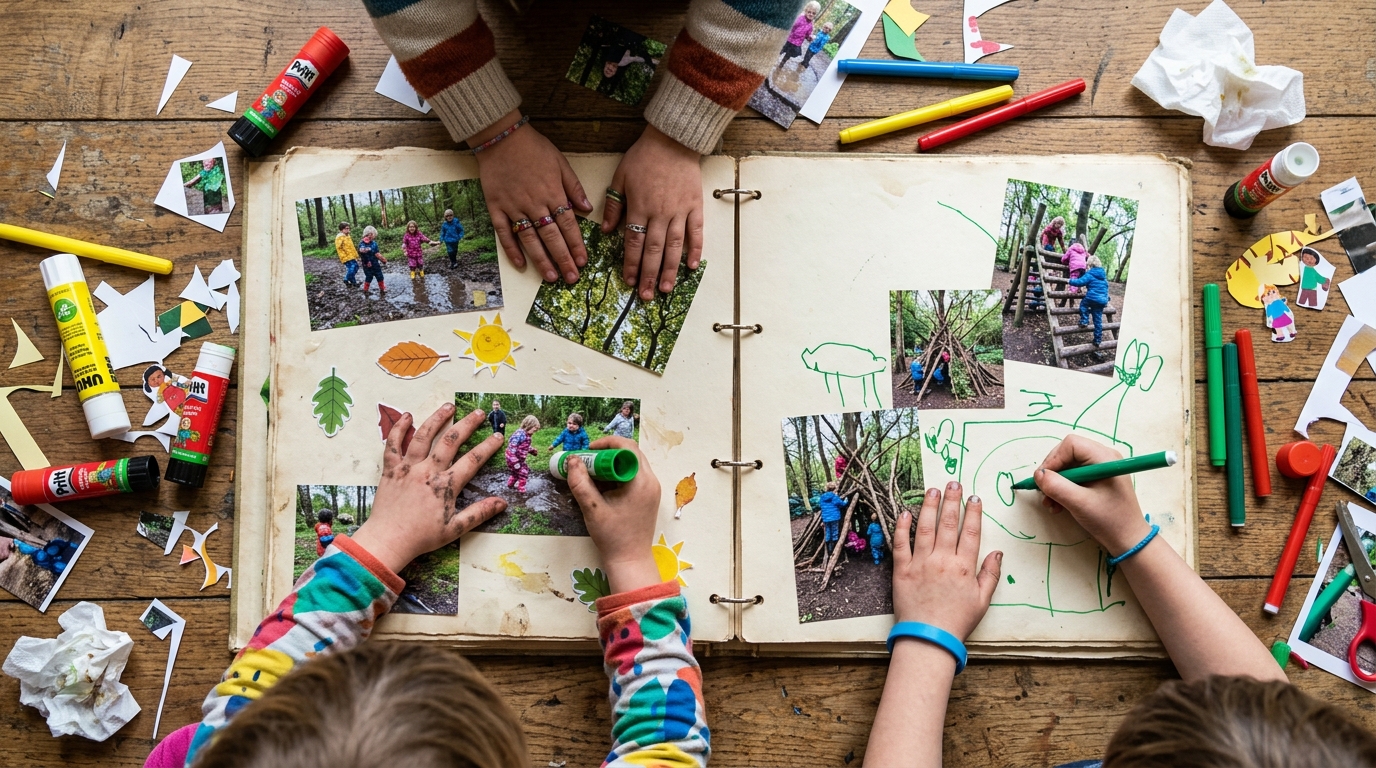
**Busy ECT Pro-Tip:** Have children draw, paint, or write on separate scraps of paper first before pasting them into the Floorbook. This ensures quieter children have equal space, prevents one child from dominating the entire spread, and relieves anxiety about 'making mistakes' directly on the page.
Why Floorbooks Work for Emergent Curriculum
The primary challenge of an emergent, Reggio Emilia-inspired curriculum is that curiosity rarely follows a linear scope and sequence. Floorbooks provide the flexible pedagogical structure required to honour emergent learning.
Total Flexibility for the Teaching Team
Not every child is drawn to the same investigation simultaneously. A Floorbook allows different individuals and small groups to contribute at staggered times across the day or week.
Promotes Sustained Shared Thinking
When children flip back through the Floorbook, they re-activate prior knowledge, evaluate peer hypotheses, and refine their thinking based on shared visual evidence.
Builds Intrinsic Ownership & Identity
Seeing their exact words, drawings, and photographs honoured in a substantial, permanent book dramatically elevates children's self-concept as capable researchers and contributors.
Visualises Organic Learning Webs
The back spreads of a Floorbook can be used to map emergent 'learning webs'. If an investigation into 'Shadows' branches into 'Light Sources' for one group and 'Tracing Silhouettes' for another, the web makes this divergence visible to educators, families, and assessment officers.
**EYLF V2.0 Connection (Outcome 4.2 & 5.1):** Children develop problem-solving, inquiry, and experimentation skills as they formulate hypotheses and represent their thinking using multimodal literacies.
4 Practical Steps to Implement Floorbooks Tomorrow
Transitioning to Floorbooks doesn't require complicated systems or elaborate stationery. Start simple with these four classroom-proven strategies:
Step 1
The Simple Setup: Acquire a large A3 or A2 spiral blank book with heavyweight paper. Place it on a designated low rug alongside glue sticks, washable markers, scissors, and a basket of paper offcuts. Let children know: 'This is our room's thinking book.'
Step 2
Photographs as Provocations: Scatter uncaptioned photographs from the previous day's play around the open pages. Offer a gentle open invitation: 'I noticed lots of thinking happening in the sandpit yesterday. Tell me about what you were exploring here.' Step back and let the children paste and annotate.
Step 3
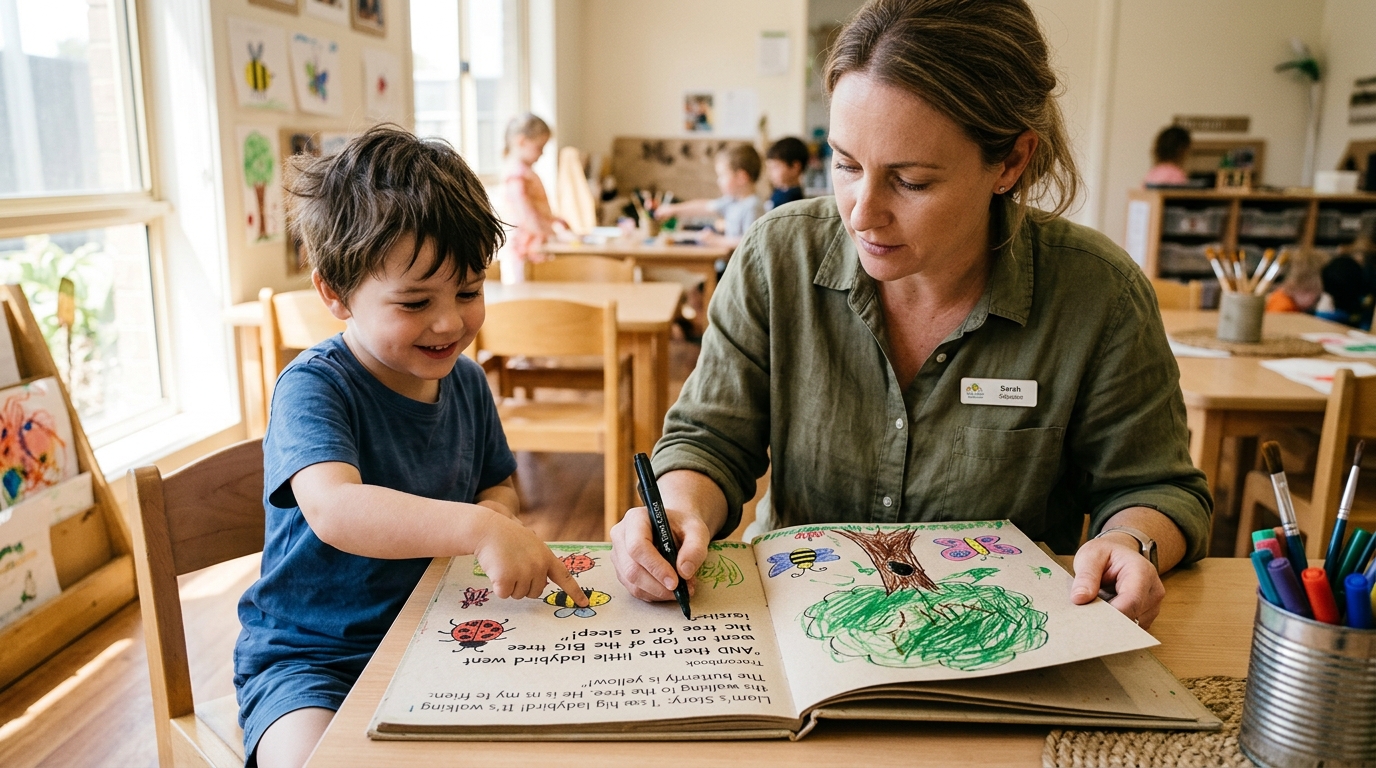
The Educator as Scribe and Thought Partner: Your role is active observation and active listening. Write down children's exact spoken words in quotation marks, preserving grammatical nuances and creative theories. If speech moves too quickly, use a voice memo app on your room tablet and scribe quotes during planning time.
Step 4
Closing the Planning Loop: Use Floorbook pages during your non-contact planning time to guide your environmental setups. What unanswered questions emerged? What misconceptions need a new provocation? Note your pedagogical reflections directly on sticky notes in the margins.
Bringing It All Together: Pedagogical Reflection for Teams
Adopting Floorbooks in early childhood requires a philosophical shift from recording what was taught to documenting how thinking unfolds. When educators step away from clipboard checklists and sit on the carpet alongside children, documentation transforms from a compliance burden into a joyful, co-constructed celebration of learning.
**Critical Reflection for Educational Leaders:** How does your room's current documentation make children's voices visible? Are your portfolios co-created with children, or primarily assembled by educators for an adult audience? What is one inquiry this week that could move to the floor?